Sit Down, Shut Up, Choose Wisely: The Secret Geography of a Comedy Club

There is a moment, roughly ninety seconds after the doors open, when a comedy club stops being a room and becomes a personality test. You stand there clutching a warm pint, squinting into the gloom, and you make a choice. Front row? Back wall? That odd little table by the toilet that looks like it was added as an afterthought by a man with a drill and a grudge? Congratulations. You have just told the room exactly who you are.
The trouble is that most people read the seating plan like a restaurant menu: the best seats are the ones nearest the stage. This is not true in comedy. It is true in theatre, where the actors are paid to pretend you aren't there. In comedy, you are the show's second act, and the closer you sit, the more likely you are to be drafted into it.
So before you book, before you queue, before you let a bloke with a clipboard shepherd you towards the middle of the second row like a sheep into a dip, read the map. The room has geography. It has weather. It has fault lines.
The Front Row Is Not a Seat, It's a Witness Stand
Let's be clear about what the front row actually is. It is not prime viewing. It is a witness box with a drinks licence and a spotlight that finds you like a sniffer dog.
Sit there and you surrender your anonymity. The compère will clock you before he's finished saying good evening. He'll ask your name, your job, and — if he's any good — the exact nature of your relationship with the person beside you. You will become a running gag. By the interval you'll have a nickname, a theme tune and a reputation you did not consent to.
There is a myth that the front row is where the biggest laughs happen. Nonsense. The biggest laughs happen at the back, from people who are free to laugh at the poor soul in the front row without being asked what they do for a living.
The front row is also the worst place to be if you need the loo, the bar, or a moment to compose yourself. You are pinned. You are visible. You are, in the words of every heckler who's ever been escorted out, "part of it now, mate".
The Pillar Seat: Britain's Greatest Architectural Betrayal
Every comedy room in the country has one. The pillar. The beam. The bit of wall that juts out six inches past where the architect promised and blocks the view of roughly a fifth of the stage.
Ticket sites don't mention it. The poster doesn't mention it. The door person will mention it only if you ask, and even then in the tone of a man who has been asked this question every Friday for nine years and has stopped caring.
The pillar seat is where the phrase "restricted view" was invented. You will spend the entire first half leaning left like a dog with an ear infection. The comic will do a mime, and you will miss it. The comic will do a face, and you will get half a face. And at some point, a stranger behind you will lean over and whisper, "he's better than this, you know", which is the least comforting sentence in the English language.
My advice: if the seat is cheap and the pillar is thick, ask yourself what you're actually there for. If the answer is "the atmosphere", take it. If the answer is "to see the show", run.
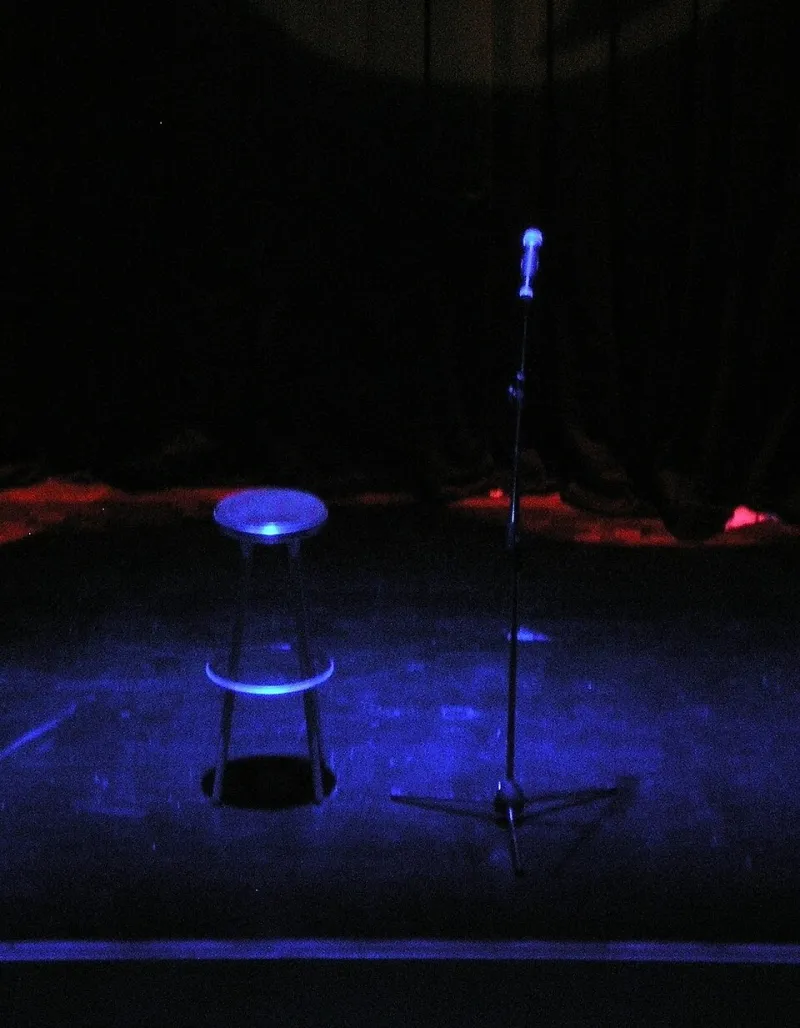
The Bar Stool at the Back: A Quiet Masterstroke
Now here is the seat nobody talks about. The bar stool at the back. The one by the fire exit, or the coat rack, or the bit where the sound desk lives.
It looks like a punishment. It is actually a promotion. From the back you can see the whole room — the heckler warming up, the couple having a domestic in the corner, the bloke who's had four pints and is about to become a medical incident. You are part of the audience but you are also, crucially, not in the firing line.
Comics respect the back. They know the back is where the quiet ones sit, and the quiet ones are either the best laughers or the people who've come to steal material. Either way, you'll be left alone. The bar stool is the comedy equivalent of sitting at the back of the bus with a hood up. You see everything. You say nothing. You leave first.
The Clipboard Politics of Being Moved
There is no more British experience than being moved by a door person with a clipboard. It is a small, polite act of violence.
"Sorry, love, we're just going to shuffle you down a bit." Shuffle. Down. A bit. You are now four rows closer to a man who is going to ask you what you do for a living. You did not agree to this. You have been rezoned.
The clipboard is a position of enormous power and it is wielded with the casualness of a teacher moving a disruptive child. If you're in a group of six, you will be split up. If you're a couple, you will be seated next to a stranger who will lean into your conversation like a man who's lost his own. If you're on your own, you will be moved to the front, because the front row needs filling and you look like someone who won't make a fuss.
My tip: ask where you're going before you hand over the ticket. Ask nicely. Ask with the weary confidence of a man who has been moved before and knows how this ends. Sometimes they'll give you the seat you wanted. Sometimes they'll give you the pillar. Either way, you've established that you're paying attention, which is more than most of the room can say.
Sightlines, Sight Gags and the Two-Pint Rule
The best seat in any comedy club is the one where you can see the comic's face and the comic can't see yours. This is harder than it sounds. Most British comedy rooms are basement prisons with ceilings low enough to give a tall man a headache and sightlines designed by someone who had never sat in a chair.
A few rules. Never sit behind a tall man with a big head. Never sit in front of a hen party. Never sit at a table where the candle is taller than the drinks menu, because you will spend the whole night looking at a wax tower. And never, ever sit in the seat that faces the mirror behind the bar, because you will catch your own eye mid-laugh and lose the will to live.
The two-pint rule is also worth remembering. Two pints and you're relaxed, generous, a good audience. Three pints and you're a liability — louder than the comic, funnier than the comic, and about to be asked to leave by a man with a clipboard who has done this before.
What Your Seat Says About You
Front row: you want to be on telly, or you're on a date and you've misread the room. Second row: you want to be near the action but not in it. A coward with ambitions. Middle of the room: you're here for the comedy. Good for you. Boring, but good for you. Back row: you've been before. You know the score. You've brought a coat and you're not afraid to use it. Pillar seat: you booked late, you saved a fiver, and you will mention it to everyone for the rest of the night. Bar stool: you are the most interesting person in the room and you know it.
The Survivor's Checklist
Arrive early, because the best seats are the ones nobody's bothered to claim yet. Sit where you can see the comic's eyes. Avoid the pillar, the front row and the stag do in matching shirts. Keep your coat on the back of your chair so nobody nicks your seat while you're at the bar. And if a man with a clipboard approaches, smile, nod, and ask him where the pillar is. He'll respect you for it.
The front row is a lie. The bar stool is the truth. And the best seat in the house is the one you chose yourself.