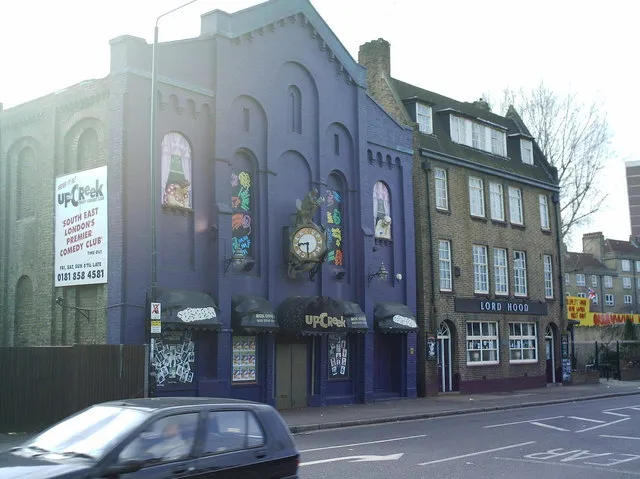
Clank, Rattle and Punchline: How Britain's Worst Comedy Rooms Make the Best Nights

There is a moment, roughly eleven minutes into the middle set, when the radiator behind the stage decides to have its say. Not a polite hiss. A full cast-iron clank, the kind a Victorian plumber would frame and hang on the wall, landing bang on the punchline of a joke about a mother-in-law. The comic stops. The room stops. Then four people laugh at the radiator, and the gig is suddenly, irreversibly, better than it was thirty seconds ago.
That is the secret of Britain's comedy underbelly, and nobody puts it on the poster.
The Room Is a Co-Star and It Hasn't Read the Script
Comics talk about 'the room' as though it were a living thing — a difficult relative at Christmas, or a dog that might bite. In the basements and back rooms of British pubs, that isn't a metaphor. Most of these spaces were built for storing barrels, hosting darts leagues and hiding from the Luftwaffe. Nobody had a microphone in mind. The acoustics were an afterthought and the ceiling height was a health-and-safety decision taken in 1897.
Which is precisely why they work. A purpose-built comedy club is a room that says yes. A cellar under a Sam Smith's pub says 'go on then, impress me' — and there is nothing a comic enjoys more than a fight he can win.
Low Ceilings, or the Democracy of Sweat
Any venue described as 'underground' is telling you two things: the ceiling is within headbutt range, and the carpet has seen things. Low ceilings do something peculiar to laughter. Sound can't go up, so it goes out — sideways, into the walls, into the back of your neck. A laugh in a low room sounds closer than it should. And closer is funnier, because laughter is a contagion and punters can feel the person beside them doing it.
It also gets warm. Warm is good. A cold room is a room waiting to leave. A warm room is a conspiracy, and conspiracies laugh louder.
The Radiator, the Fridge and the Glass Washer: A Rhythm Section
The radiator is the finest timing instrument in British comedy and it has never once been credited.
Then there's the fridge. Every bar cellar has one, and every cellar fridge hums in the key of B-flat through the quiet bits of a story about a dead grandfather. The glass washer is a scheduled heckle: it kicks into its spin cycle in the final ten minutes of a set and screams through the punchline like a man being shown a spider. The pub telly in the corner, sound down, carries a silent crowd celebrating a goal directly behind the comic's head — a mime artist working against him.
The comic's job is not to eliminate these noises. It is to make them part of the act. Good comics get a laugh off the glass washer. Great ones behave as though they booked it.
Squeaky Stairs and the Latecomer Economy
Every venue has a staircase that functions as an unpaid compère, announcing arrivals in a language of creaks. There is also the door that opens the wrong way, the curtain that isn't a curtain but a length of function-room fabric you must walk through like a man emerging from a car wash, and the latecomer in a fleece climbing the stairs with four pints at the exact moment the headliner goes for the emotional bit.
'That's the last person who'll ever come to your gig,' the comic says, and the room decides. Usually, mercifully, it laughs with him rather than at him. That decision — made in a cellar, by strangers, in under a second — is the whole job.
Reading a Room Before the First Joke: A Field Guide
Before a comic has said hello, the architecture has already grassed up the entire night.
The beam. If there's a structural beam within two feet of the mic stand, the comic will spend forty per cent of the set ducking it and sixty per cent pretending the ducking is a deliberate bit. Watch for it. It's the closest the circuit gets to physical comedy.
The pillar. A pillar splits a room into 'the front' and 'the people who came for the darts'. If a comic spends the night circling it, they aren't being dynamic; they're doing laps around a geological feature.
The chalkboard. 'COMEDY NIGHT — TONIGHT 8PM — £5.' If it's chalk, the promoter is a romantic. If it's a laminated A4, the promoter has been doing this since 2009 and knows exactly what happens to chalk in a cellar.
The fire door. Where the smoking area's noise gets in and the laughter gets out. Propped open with a bucket? Expect heckles from the courtyard.
The ceiling tiles. Count them. Under forty and you've got intimacy. Over a hundred and you've got a room the comic must fill with personality, which is a far bigger job.
The carpet. Patterned means the venue has learned. Plain means the venue has learned nothing but does own a mop.
Why Nobody Should Renovate These Rooms
Every few years a pub gets a refit and the cellar becomes 'The Loft' with exposed brick, a proper PA and a drinks menu involving basil. Everyone says it's an improvement. Technically, it is. But something goes out of it — the sense that the show is happening somewhere it isn't supposed to, which is ninety per cent of the thrill. Comedy in a comedy venue is a service. Comedy in a cellar beside a radiator is a conspiracy, and the radiator is in on it.
So here's to the clank. May it always arrive late, land badly, and improve the night.